The Electric Life of Michael Faraday by Alan Hirshfeld
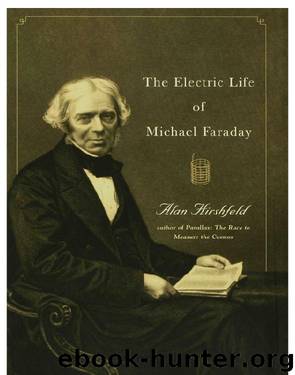
Author:Alan Hirshfeld
Language: eng
Format: epub
Publisher: Bloomsbury Publishing Plc
Published: 2009-07-16T04:00:00+00:00
Faraday resumed his investigation on September 24. Now his aim was different: to induce current, not through electromagnetism, as he already had, but with an ordinary magnet. (He had not yet convinced himself that the two magnetisms were identical, so the focus of his induction attempts alternated between them.) Deriving electricity from a magnet, Faraday assumed would be the greater challenge. A magnet's halo of power is more diffuse than that of an electromagnetic coil, and any induced current would likely be harder to detect.
First he brought a bar magnet toward a flat spiral of wire, then yanked it away—the galvanometer needle remained fixed. Next he inserted a wire spiral between a pair of magnetic poles and changed the gap between them-no induction. Then, briefly returning to the electromagnetic side of his investigation, he placed a current-carrying coil and a passive coil side by side—again, no response. When iron coils produced no result, he tried copper—still nothing.(In all these cases, the induction effect was merely too subtle to be registered by the galvanometer.) Finally, toward day's end, he tied together the ends of two bar magnets to form a hinged, V-shaped "jaw," within which he secured a small, upright, coil-enshrouded iron cylinder. The coil-ends he connected to the galvanometer. Every time he opened or closed the magnetic jaw, varying the magnetic state of the iron, the needle flicked: "a mere momentary push or pull," Faraday jotted in his diary; nevertheless, "here distinct conversion of Magnetism into Electricity." It was his only success of the day, yet one of great moment: For the first time electricity had been generated from an ordinary magnet.
Resuming his experiments on October 1, Faraday succeeded again with the iron ring-"powerful effect. . . pulling the needle quite round," he exulted in his diary. He next addressed a crucial point that a lesser researcher might have taken for granted: proving that the induced energy in the secondary coil, presumed to be ordinary electricity, is in fact ordinary electricity. That is, does the induced energy behave in every way like familiar static and voltaic electricity? Faraday put away the galvanometer. Instead, to the wire-ends of the secondary coil, he attached metal or carbon rods-electrodes. He held the electrodes to his tongue while the induction process was carried out, bracing himself for the expected sting of electricity. It never came. Instead, he plunged the electrodes into various acid solutions, hoping to trigger familiar electrochemical reactions. The solutions remained unaffected. Nor did his most sensitive measurements disclose even the slightest electrical heating of the secondary wire. The spurts of induced current were evidently too brief and too weak to reveal themselves in the usual ways. Fortunately, other electrical behaviors were manifest. The halo of magnetism from the pulses of induced current was sufficient to magnetize needles. And Faraday did manage to coax a minuscule spark from a secondary coil by routing the induced energy into the narrow gap between two carbon electrodes. (When he demonstrated this spark phenomenon to an
Download
This site does not store any files on its server. We only index and link to content provided by other sites. Please contact the content providers to delete copyright contents if any and email us, we'll remove relevant links or contents immediately.
Hit Refresh by Satya Nadella(9116)
When Breath Becomes Air by Paul Kalanithi(8418)
The Girl Without a Voice by Casey Watson(7877)
A Court of Wings and Ruin by Sarah J. Maas(7807)
Do No Harm Stories of Life, Death and Brain Surgery by Henry Marsh(6931)
Shoe Dog by Phil Knight(5252)
The Rules Do Not Apply by Ariel Levy(4953)
A Higher Loyalty: Truth, Lies, and Leadership by James Comey(4946)
Hunger by Roxane Gay(4920)
Tuesdays with Morrie by Mitch Albom(4763)
Everything Happens for a Reason by Kate Bowler(4729)
The Immortal Life of Henrietta Lacks by Rebecca Skloot(4571)
Millionaire: The Philanderer, Gambler, and Duelist Who Invented Modern Finance by Janet Gleeson(4457)
How to Change Your Mind by Michael Pollan(4350)
All Creatures Great and Small by James Herriot(4303)
The Money Culture by Michael Lewis(4186)
Man and His Symbols by Carl Gustav Jung(4120)
Elon Musk by Ashlee Vance(4118)
Tokyo Vice: An American Reporter on the Police Beat in Japan by Jake Adelstein(3973)
